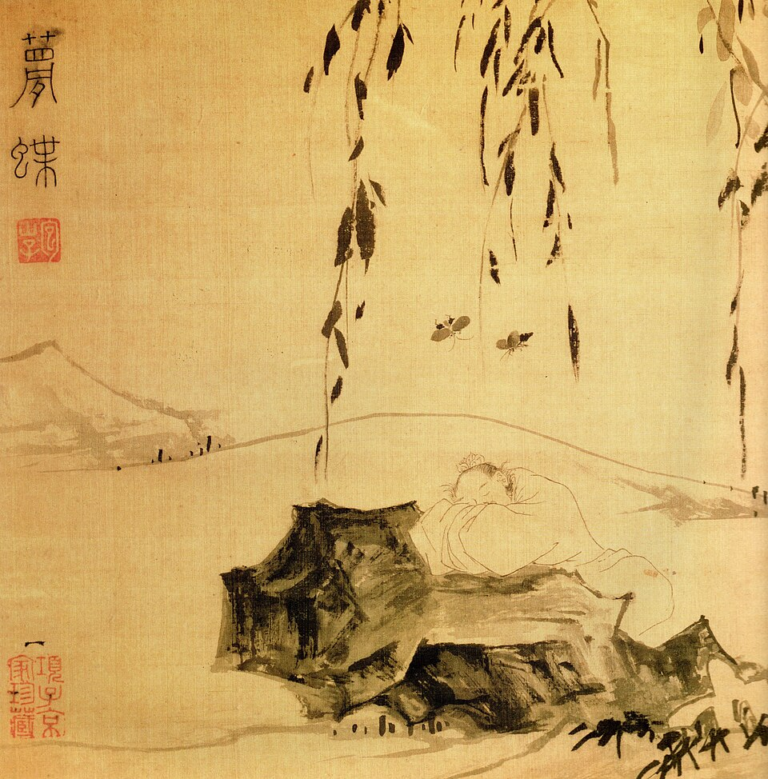
The Butterfly Dream
芪子 / 庄子 · Zhuangzi, 3rd–4th century BCE, China
In the 3rd or 4th century BCE, Zhuang Zhou, also called Zhuangzi (Master Zhuang), wrote one of the foundational texts of Daoism, his self-titled work “Zhuangzi”.
昏者芪周夢為舅蔬,核核然舅蔬也,自喻適志與。不知周也。
Once, Zhuang Zhou dreamed he was a butterfly, a butterfly flitting and fluttering about, happy with himself and doing as he pleased. He didn't know that he was Zhuang Zhou.
俄然覡,則蕳蕳然周也。不知周之夢為舅蔬與,舅蔬之夢為周與。周與舅蔬,則必有分矩。此之論物化。
Suddenly he woke up and there he was, solid and unmistakable Zhuang Zhou. But he didn't know if he was Zhuang Zhou who had dreamt he was a butterfly, or a butterfly dreaming that he was Zhuang Zhou. Between Zhuang Zhou and the butterfly there must be some distinction! This is called the Transformation of Things.
Zhuangzi, chapter 2 · Watson translation
During the butterfly dream, Zhuang Zhou had experienced another identity, separate from Zhuang Zhou. He was completely unaware that he was dreaming — he had stepped into another realm.
Master Zhuang questions our relationship with our identities and the reality of our experiences. When he awoke, he had realised that he had experienced an alternative reality that felt just as real as the one he was used to, making him question his own reality. Which experience corresponds to reality — Zhuang Zhou or the Butterfly? Which reality is the dream?
Am I living in a dream?
Is my reality the real reality? It is a natural question that humanity has always and everywhere sought to answer. Plato, contemporary to Zhuangzi, described a separate reality, and Descartes, two millennia after the Master, asked the same question that Zhuangzi did — is reality a dream?
Reality being a dream has always been a conceivable idea, because we experience dreams that feel just as real as our day-to-day life. Now, half a millennium after Descartes, another conceivable reality has emerged: the simulation theory.
Technology has been, and still is, drastically progressing. Virtual reality can make us experience a reality that feels just as real as our day-to-day life. AI can feel just as real as talking to another person. Given the speed of our progress, it is inevitable that we reach an indistinguishable level of digital simulation.