History of Quantum Physics
Rendering Reality · from Newton's certainty to Schrödinger's cat, 1704–1935
Scientific Certainty (XVII to XIX Century)
In 1704, the genius Isaac Newton, father of classical mechanics, proposed the corpuscular theory, arguing that light consists of particles. At this time, physics was prosperous. Thanks to classical mechanics, physics provided a simple and deterministic model of the world. The corpuscule model would fit into this predictable and beautifully logical framework – small particles that obeyed like any mechanical object, following predictable behaviour calculable using the same laws Newton used to calculate the trajectories of cannonballs and planets. For example, light reflecting off of surfacing was seen as an elastic collision.
At the same time, Christiaan Huygens argued that light is a wave. His theory was that light was propagated as a longitudinal wave through a medium called “ether”, with each wavefront acting as a source of secondary waves. In this model, light reflects off of a mirror because the secondary waves hitting the surface would bounce back.
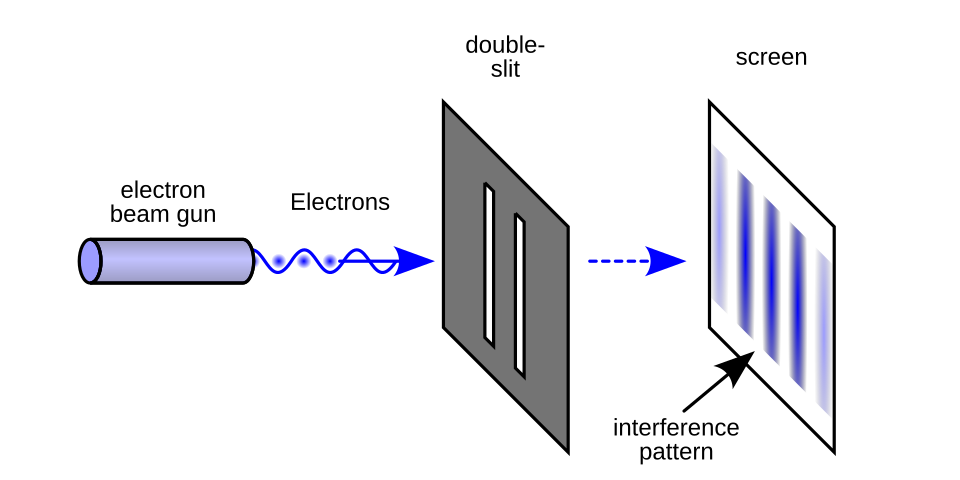
In 1801, the famous Double-Slit experiment was conducted by Thomas Young. By passing light through two slits, he observed an interference pattern, with bright and dark fringes. The corpuscular model would mean that the experiment would result in two bands of light, as the corpuscules would pass through the two slits in a straight line. However, the experiment proved that light diffracts as it passes through the slits, and the light waves passing through each slit interfere with each other, creating the interference pattern. The brighter fringes being where constructive interference occurs and the darker ones, destructive interference.
Six decades later, Maxwell's equations would show that light is an electromagnetic wave by unifying electricity and magnetism. A changing electric field creates a magnetic field, and a changing magnetic field creates an electric field. Maxwell also calculated the speed of light: 3.0 × 10⁶. Huygens wasn't entirely correct as light is a transverse wave (not longitudinal), and what we see is only the visible part of a whole spectrum.
“We can scarcely avoid the inference that light consists in the transverse undulations of the same medium which is the cause of electric and magnetic phenomena.”
Maxwell, “On Physical Lines of Force”, 1861At this point, reality itself seemed almost entirely explained. When Urbain Le Verrier discovered Neptune by calculation using Newton's theory of gravitation, confirmed by observation in 1846, it seemed as though the cosmos' mysteries had been cracked by science. Maxwell's equations and the Lorentz force law unified electricity, magnetism and light into a single framework spanning microscopic and macroscopic scales, while thermodynamics explained energy and temperature.
“the future truths of physical science are to be looked for in the sixth place of decimals.”
Albert A. Michelson, Princeton University catalog of 1896Quanta (1900)
At the end of the 19th century, there was a clear vision in physics thanks to Maxwell's breakthrough in electromagnetism and thermodynamics. Physicists tried to use his theories to explain Blackbody radiation – how hot objects emit light and heat.
The problem was that when scientists calculated how much energy a hot object should emit, their calculations said that as the frequency of light got higher, the amount of energy emitted should approach infinity, which is impossible as not only does it breach the conservation of energy, but it would mean that we would be receiving lethal doses of UV and X rays daily.
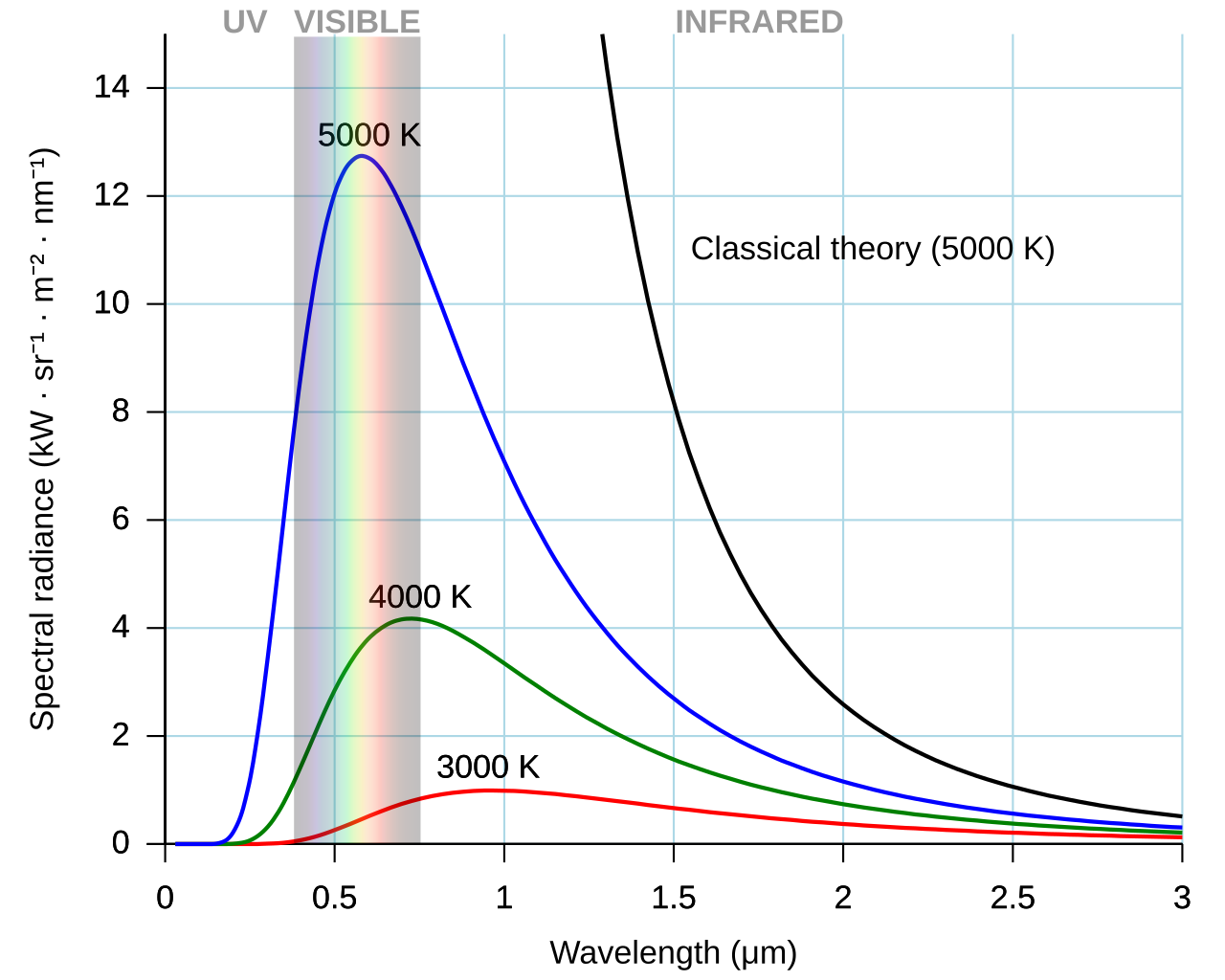
The empirically obtained Rayleigh-Jean's law (classical theory) predicted the trend for long wavelengths, but failed for shorter ones. This became known as the ultraviolet catastrophe, a term first used by Paul Ehrenfest.
In 1900, Max Planck solved the problem. Max Planck was a cautious man and a conservative scientist, albeit open to discussion. He had known the time of booming science, German romanticism and positivism. Scientists were focused on efficiency; physics formulas worked in applications – why be concerned with that which we cannot see?
However, he took a risk he himself did not believe in: quanta. In order to solve the blackbody radiation, he introduced what was to him a “mathematical trick”. He proposed that the emission or absorption of energy was restricted to discrete packets of energy. Not energy itself, but the trade of energy. He called these quanta, from the Latin for “how much”.
E = hf
Where E is energy of each packet, f is frequency, and h is Planck's constant.
This equation states that the energy of each packet is proportional to the wave's frequency. Energy transfer must be a multiple of hf → 0, hf, 2hf, 3hf … nhf.
This meant that a massive single packet of energy was needed to emit high-frequency ultraviolet light (where Rayleigh-Jean's law calculated infinite energy). This solved the ultraviolet catastrophe. Planck's curve (in blue in the graph) perfectly matched empirical trends.
Quantisation of Light, Matter and Energy
Quantisation of Light (A Nobel Discovery)
1905 was Einstein's Annus Mirabilis (Miracle Year). He and Newton were geniuses of the same caliber.
In his miracle year, Einstein explained the Photoelectric Effect, which is the emission of electrons from a material's surface when electromagnetic radiation shines on it. Classical physics predicted that if you shone an intense light, the waves would heat up electrons until they flew off; a very dim light wouldn't knock out electrons right away because they would need time to absorb enough wave energy. That is, (according to Maxwell's description of light waves) the continuous energy from electromagnetic waves must build up or be concentrated enough to knock out electrons. However, experiments showed the exact opposite: intensity didn't matter, colour (frequency) did. A blindingly bright red light would emit zero electrons, but a tiny dim spark of ultraviolet light would instantly knock electrons free.
Einstein proposed a radical insight that light is actually made of discrete, localised packets of energy called light quanta – later named photons. He applied Planck's “mathematical trick” to light itself. This explained the empirical results of the photoelectric effect: in a collision, a photon (behaving like a particle) transfers all its energy to one electron. High-frequency light has high energy photons that easily kick out electrons; low-frequency light has low-energy photons that bounce off harmlessly no matter the intensity, hence why colour affects the emission of electrons and not intensity.
Remember Planck's equation E = hf.
The energy of each photon is proportional to the frequency of the wave.
This is what earned Einstein his 1921 Nobel Prize in Physics.
Quantisation of Matter and Energy
In 1924, French physicist Louis de Broglie took this further by putting forward a radical new hypothesis: matter waves. He hypothesized that if light waves can act like particles, then material particles (like electrons) should also act like waves (matter waves). This was accidentally confirmed in 1927 by the Davisson-Germer experiment, observing a diffraction pattern in electrons.
The De Broglie wavelength formula was introduced.
λ = h ⁄ mv
Where lambda is wavelength, h is Planck's constant, m is mass and v is velocity (mv = p, momentum).
This means that any particle or object has a wavelength. This is more prominent in tiny masses like electrons, because since the denominator is so tiny, the wavelength is more significant than in big everyday objects.
Quantisation in the universe was explained by this. Before De Broglie, Bohr had already said that electrons were quantised (can only sit in specific positions in the atom), although there was no explanation as to why this was the case. According to De Broglie's theory, which gave each electron an inherent wavelength, this was the result of stationary waves being created at positions around the atom nucleus. A stationary wave is created only at specific wavelengths, in which the wave interferes with itself. At any other wavelength, the wave would cause destructive interference, breaking the harmony. Hence, the electron is quantised as it can only sit at the specific wavelengths which create the stationary waves. These exist at different energy levels, hence quantising energy.
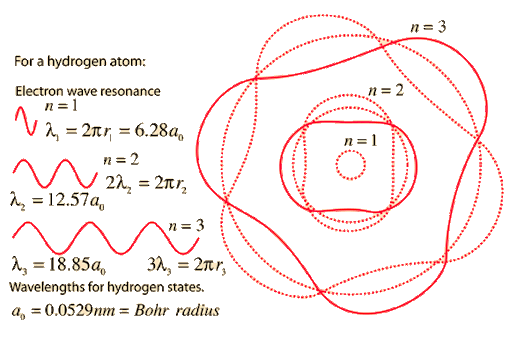
This was an entirely new model of the atom.
Schrödinger's Butterfly
Schrödinger's Equation (A Nobel Equation)
The introduction of matter waves was the conceptual opening for superposition: if something is a wave, it can overlap with itself and interfere, and two wave states can add together to make a new valid state.
At the same time matrix mechanics – representing quantities like position and momentum as matrices rather than ordinary numbers – Schrödinger developed wave mechanics. Schrödinger published his famous equation in 1926 that describes how the quantum state of a physical system changes over time. It can be seen as the quantum counterpart of Newton's second law (F = ma). While Newton's second law predicts the trajectory of objects, Schrödinger's equation calculates a wave function Ψ (Psi). This work was what earned Schrödinger his 1933 Nobel Prize in Physics.
iℏddt|Ψ⟩ = Ĥ|Ψ⟩
The time-dependent Schrödinger equation.
A crucial mathematical property of Schrödinger's equation is that it is a linear differential equation. Therefore, it obeys the mathematical principle of superposition, which is satisfied for any equation that fulfills the mathematical property known as linearity.
Linearity depends on two factors: additivity – the superposition property – (if you add two inputs together, the output is the sum of their individual outputs) and homogeneity (if you multiply an input by a constant factor, the output is multiplied by that same factor).
f(ax₁ + bx₂) = a·f(x₁) + b·f(x₂)
The linearity condition that Schrödinger's equation satisfies.
What this means for Schrödinger's equation is that if state ψ₁ is a valid solution and state ψ₂ is too, then a combined state (ψ₁ + ψ₂) is also a perfectly valid solution. The maths demands that particles can exist in multiple states at once. The superposition of particles is mathematically inevitable.
Born's interpretation (1926) adds on to Schrödinger's equation, proposing that the wave function's square gives the probability density of a particle's position and the state it is in. This reframed superposition: particles are in a weighted combination of possible states at any given moment before measurement or interaction.
In Paul Dirac's 1930 book “The Principles of Quantum Mechanics”, Paul Dirac gave the idea of superposition its cleanest formal language. He introduced the general framework of state vectors in an abstract vector space (later formalised as Hilbert space), along with the bra-ket notation still used today. In this language, superposition is simply vector addition: any linear combination of valid quantum states is itself a valid quantum state.
Rendering Reality
When he introduced the uncertainty principle in his foundational 1927 paper, Heisenberg also became the first to use the idea of wave function collapse to explain the transition from superposition to definite measurements. When a superposed particle undergoes an interaction or is observed, it “chooses” a state and stops existing in various simultaneous ones.
This was integrated into mathematics by the virtuous polymath John von Neumann in his 1932 book “Mathematical Foundations of Quantum Mechanics”. He formalised Hilbert spaces as the proper setting for quantum states and clarified the distinction between the smooth, linear evolution of superposition governed by Schrödinger's equation and the collapse that occurs upon measurement.
Remember Young's experiment? Due to the wave function collapse, if you use a measuring device to observe through which slit electrons have passed through, the interference pattern breaks down.
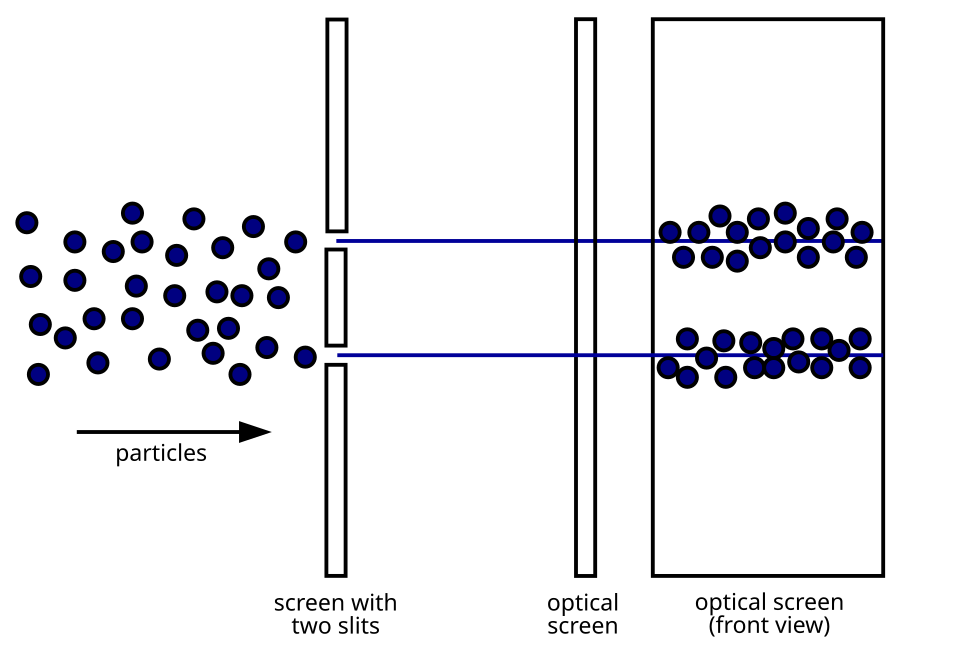
Another key point: superposition does not occur at macroscopic levels because objects are undergoing constant interactions with their surroundings. The atoms they are made up of are constantly colliding with one another. The wave is perpetually collapsed.
The Great Debate
The Einstein–Podolsky–Rosen (EPR) paper from 1935 titled “Can Quantum-Mechanical Description of Physical Reality be Considered Complete?” – which described the phenomena of entanglement (a term later introduced by Schrödinger) – concluded that quantum mechanics was incomplete, introducing the possibility of there being hidden variables (“elements of reality”) we do not know of that contributed to the determination and evolution of the wave function.
Niels Bohr published a paper with the same title later that year, defending quantum mechanics and challenging the EPR hidden “elements of reality” idea. This is the Copenhagen interpretation. He believed that quantum mechanics provided a complete description of the world, maintaining that wave-particle duality and superposition were intrinsic features of reality rather than gaps in knowledge.
This was the start of the fierce debate of the 20th century. Einstein vs. Bohr.
Schrödinger and Einstein – who were in agreement – exchanged letters regarding this matter, sharing thought experiments, an approach Einstein frequently used. In these letters, Einstein imagined a scenario in which quantum superposition affected a larger system, causing superposition on a macroscopic level. Superposition is a phenomenon that affects reality at an atomic level since objects too big do not experience superposition due to constant interactions between the atoms that make them up. Einstein highlighted that the state of an unstable keg of gunpowder will eventually contain a superposition of both exploded and unexploded states. The gunpowder starts off stable, in a normal macroscopic state. However, as it is chemically unstable there is a constant probability that it will spontaneously combust. Schrödinger's equations that describe the evolution of the wave function in a quantum system indicate that rather than picking a side, the wave function evolves to include both possibilities simultaneously. Bohr's interpretation of quantum mechanics would assert that the gunpowder exists in both exploded and unexploded states until observed, as described by Schrödinger's equations.
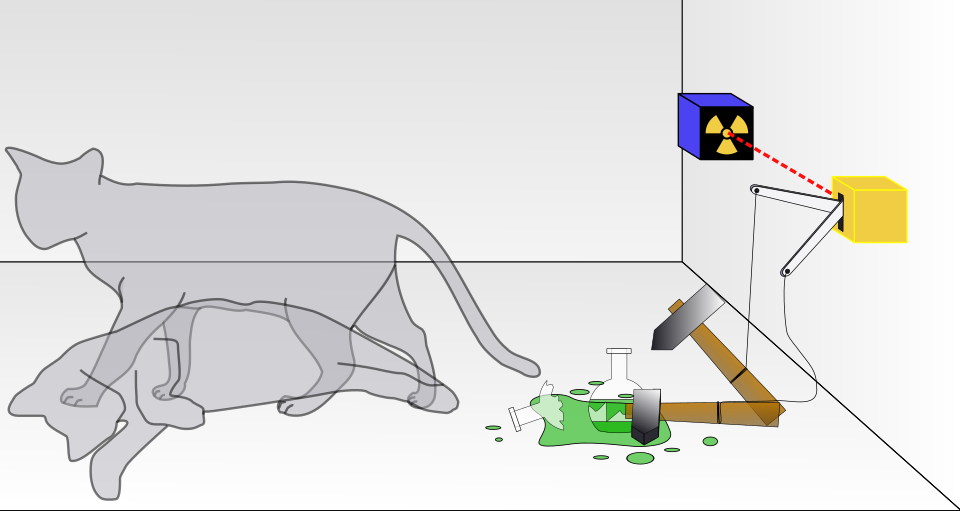
To further illustrate, Schrödinger described how, in theory, it would be possible to create a large-scale system in superposition that blurred life and death by making it dependent on a superposed quantum particle. He proposed his famous Schrödinger's cat scenario in a simple letter to Einstein. In this experiment, there is a cat enclosed in a steel chamber and a Geiger counter containing a little amount of radioactive substance with a 50% chance of decay. If decay occurs, a lethal poison is released, killing the cat. Since the chance of decay is dependant on atomic superposition in the radioactive substance, and both the decayed and non-decayed states exist, the entire system becomes superposed, therefore the cat, existing both in the large-scale states where poison was released and where it wasn't, is both dead and alive. Although Schrödinger's cat is now a popular depiction of quantum theory, Schrödinger's intention was to highlight the counterintuitive nature of quantum superposition through reductio ad absurdum.
Schrödinger, in a letter to Einstein, wrote:
“One can contrive even completely burlesque [farcical] cases. A cat is put in a steel chamber along with the following infernal device (which must be secured against direct interference by the cat): in a Geiger counter, there is a tiny amount of radioactive substance, so tiny that in the course of an hour one of the atoms will perhaps decay, but also, with equal probability, that none of them will; if it does happen, the counter tube will discharge and through a relay release a hammer that will shatter a small flask of hydrocyanic acid. If one has left this entire system to itself for an hour, one would tell oneself that the cat is still alive if no atom has decayed in the meantime. Even a single atomic decay would have poisoned it. The psi-function of the entire system would express this by having in it the living and dead cat (pardon the expression) mixed or spread out in equal parts.
It is typical of these cases that an indeterminacy originally restricted to the atomic domain turns into a sensually observable [macroscopic] indeterminacy, which can then be resolved by direct observation. This prevents us from so naïvely accepting a ‘blurred model’ as representative of reality. Per se, it would not embody anything unclear or contradictory. There is a difference between a shaky or out-of-focus photograph and a snapshot of clouds and fog banks.”
Schrödinger, letter to Einstein, 1935