Essay
A Brief History of AI
What is AI and where does it come from?
“The Analytical Engine has no pretensions whatever to originate anything. It can do whatever we know how to order it to perform.”
Ada Lovelace, on the Analytical Engine — considered the first computer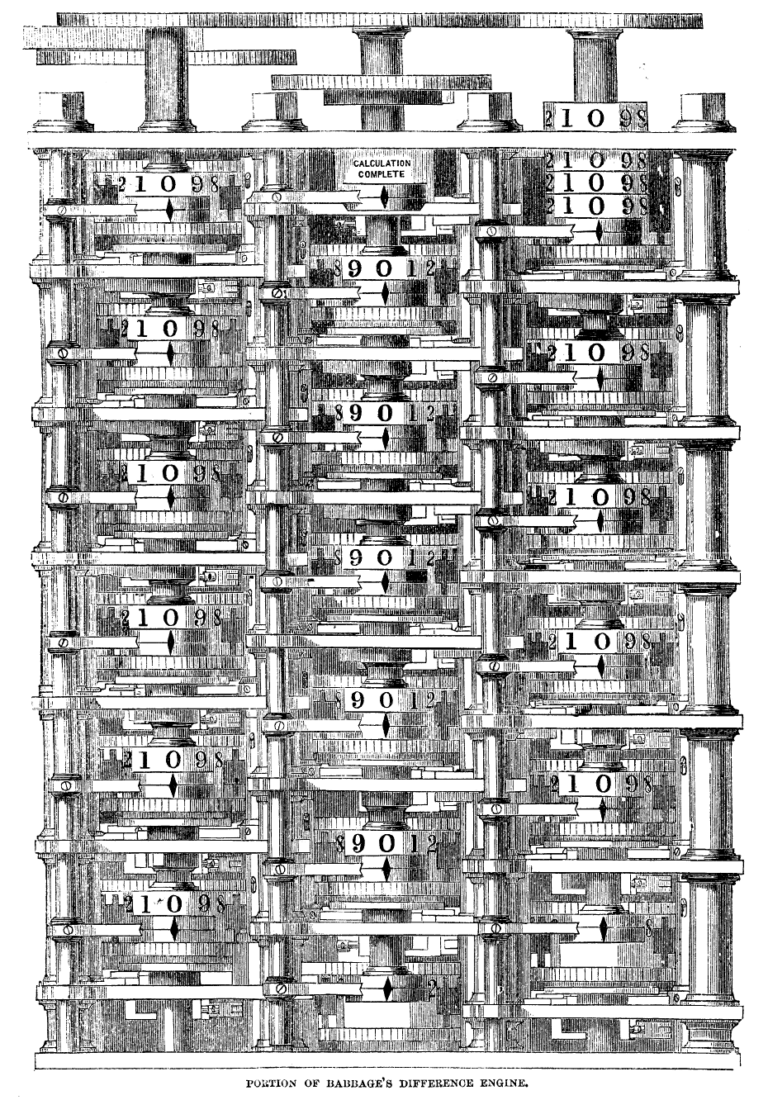
Artificial Intelligence (AI) refers to the ability of machines to perform tasks generally requiring human intelligence, such as learning, reasoning and decision-making. AI relies heavily on different algorithms, such as Machine Learning (used in Netflix recommendations, stock market predictions…), in which the AI model is trained via data input, learning to identify patterns, predict and generate; the more data it gets, the better it becomes. Deep learning requires much higher computing power and is used in AIs such as ChatGPT, self-driving cars and facial recognition. These algorithms create “neural networks” — multiple layers of data — which imitate the brain's way of processing information. Often, AIs rely on probability. For example, ChatGPT generates by predicting the next most probable word relative to the sites it was trained on; for instance, it may finish the sentence “Roses are…” with the word “red” because that is the most common word after that phrase on the internet.
There are different branches of AI: NLPs (natural language processing), vital in helping machines understand human language, used in translation programs, voice-to-text, etc; LLMs (large language models), trained to process and generate language, used to make essays, summaries…; ABMs (agent-based models), which simulate individuals — used in economics to model markets and systems, urban planning to simulate traffic, medicine to simulate disease spread, and social sciences to study behaviours. There are also LQMs (Large Quantitative Models), said to be revolutionary in medicine and finance, based on numerical and statistical data. These models use massive datasets to find correlations, which are then used to make predictions — in weather forecasting, for example, or to evaluate financial risks or model chemical reactions and predict disease outbreaks.
Since the beginning, “neural networks” were being contemplated. In the 20th century, the foundations for Artificial Intelligence were being set, starting with von Neumann's work on traditional computing and the binary code, the Turing machine (1936) and the Turing test (1950). Earliest models were used for mathematical problems (Logic Theorist, 1956; General Problem Solver, 1957). ELIZA was one of the earliest chatbots, created in 1966; it simulated human conversations but was far from where we have reached today. The actual algorithms have not changed much since the 60s, but computing power has advanced exponentially.
An important event regarding AI is when Deep Blue (an AI) defeated Garry Kasparov, the world chess champion, in 1997. This model used brute-force search, evaluating 200 million positions per second. Twenty years later, AlphaGo (developed by a Google subsidiary) defeated the world Go champion, Lee Sedol, in 2016 — the human player won only one of five games. This caused major shock amongst society, since Go is an extremely complicated game, dating back 4000 years, even described as philosophical. Compared to Deep Blue, AlphaGo was an advancement since it used neural networks and self-play to improve. A year later, AlphaGo Zero was developed without any human data (it was only given the game rules) and was able to master Go in just 40 days — when it beat AlphaGo 100–0. AI revolutionised games, especially Go, shifting the perception of ‘strong’ and ‘weak’ plays.
A turning point in AI was the launch of ChatGPT. Developed by OpenAI (founded 2015; Elon Musk was part of the nonprofit), the AI was originally created as a simple chatbot for customer service. GPT-1 arrived in 2018 (the same year Musk left, after a battle over company ownership); GPT-2 and GPT-3 followed in 2019 and 2020, going from 1.5 billion to 175 billion parameters. Finally, in 2022, GPT-3.5 came out — a breakthrough in AI. ChatGPT used RLHF (reinforcement learning from human feedback) to keep its responses safe and appropriate, trained on a database ranging over many sites, including Wikipedia and online forums. Surprisingly, despite being intended as merely a conversational bot, the AI developed unexpected abilities — notably, translation between languages and programming ability. These unintended skills showed how little we understand about AI, and led people to fear it getting out of hand.
ChatGPT's release also sparked a massive rise in investment. Since 2022, the public scene has been all about AI, and every firm wants in — there are now over 10,000 AI startups. There is a global “war” over AI, a sunrise industry, with each country trying to build the best model. The leading nations are the US and China: on the US side, Google, ChatGPT, OpenAI, Perplexity and NVIDIA; on the Chinese side, Baidu, Tencent, Alibaba and others. An important face-off between the two came with the release of DeepSeek in January 2025, which led to billions in stock market losses and shocked Silicon Valley — NVIDIA dropped almost 20% (nearly $600 billion lost), the biggest one-day drop in stock market history, as Google and Microsoft also suffered from investors' loss of confidence in US technological innovation. Why? The Chinese model performed at ChatGPT's level for far less energy and cost: ChatGPT cost over $100 billion to develop, while DeepSeek was built for around $5 million, using lower-power NVIDIA chips. Investor Marc Andreessen called it an “AI Sputnik moment”, comparing it to the USSR's satellite launch that triggered the space race. In Europe, leading firms include DeepL and Aleph Alpha (Germany) and Mistral AI (France).
Like the internet in its early days, AI has created a “bubble”: exaggerated expectations, speculation, and immense hype. Many companies and investors overestimate AI's potential, turning it into a “gold rush industry”. Despite most AI companies not yet being profitable, funding exceeded $100 billion in 2024.
This makes us all wonder: what's next?
To be continued…